
TL;DR Summary
Most resumes in 2026 are rejected by AI and ATS systems due to missing keywords, poor formatting, generic content, or unclear experience structure. This guide explains why AI resume tools reject candidates in 2026 and how to fix these issues to improve shortlisting chances. Common issues addressed AI Resume rejection reasons and Ai Resume Screening 2026 lets see the solution ahead.
Introduction Why AI Resume Tools Reject Candidates in 2026
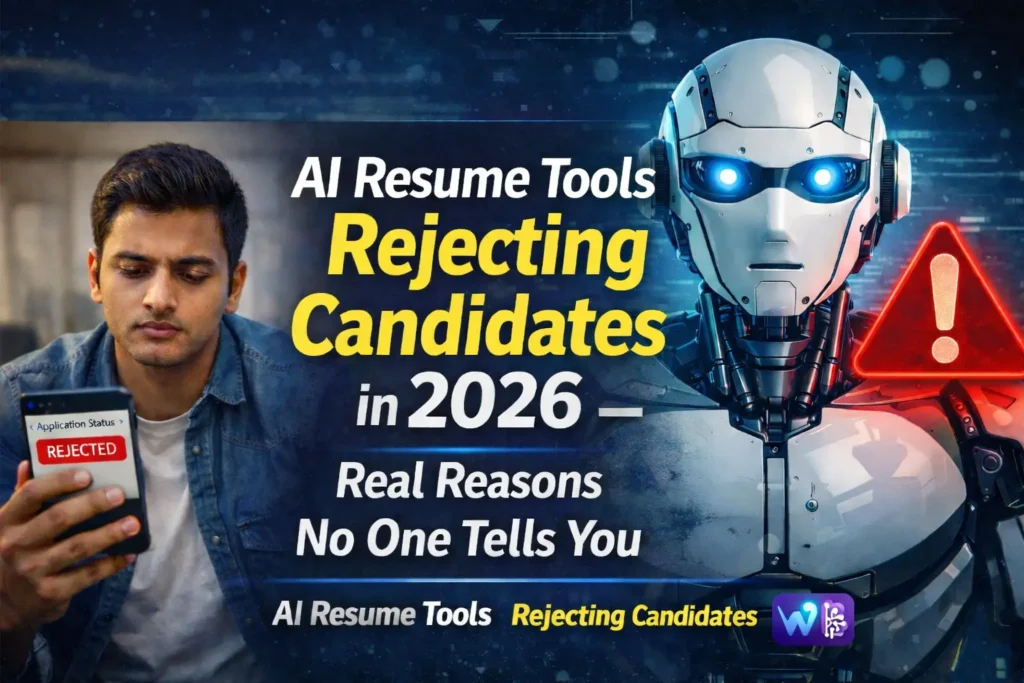
Why AI Resume Tools Rejecting Candidates in 2026, most job applications never reach human recruiters. Instead, AI-powered resume screening systems decide which candidates move forward — often within seconds.
If your resume gets rejected repeatedly, it doesn’t mean you lack skills or experience. In most cases, the problem lies in how AI resume tools interpret your profile.
Understanding how these systems work — and how to adapt to them — has become essential for career success in the modern job market.
How AI Resume Screening Works in 2026
Before fixing resume rejection issues, it is important to understand how modern AI hiring systems function.
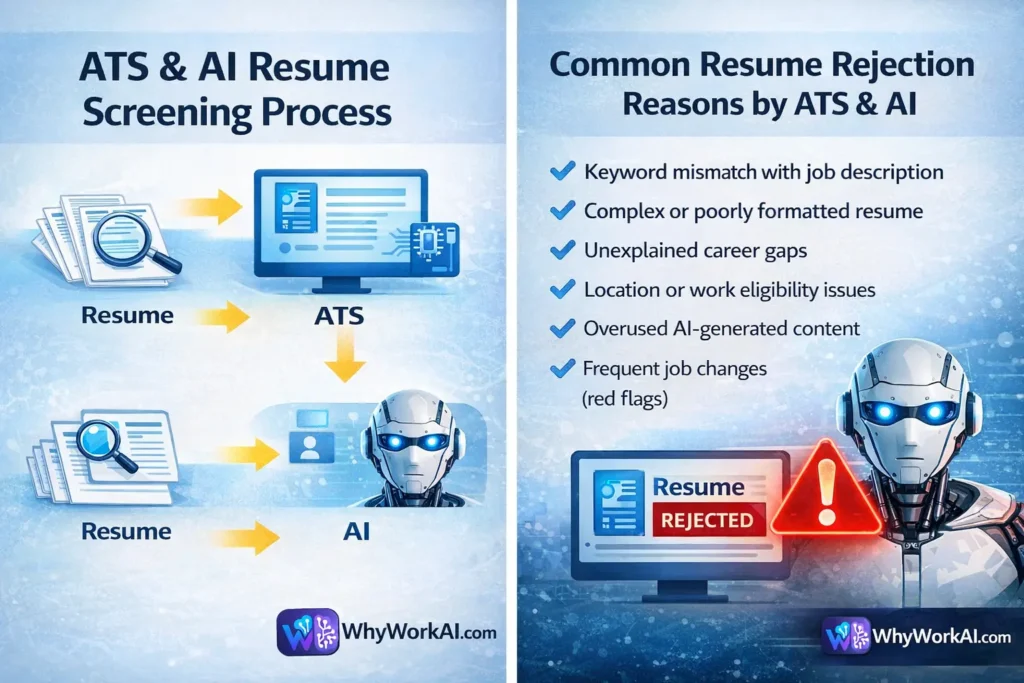
Most companies now use Applicant Tracking Systems (ATS) powered by AI to manage large volumes of applications. These systems scan, classify, and score resumes automatically before any human review.
In 2026, AI resume screening tools mainly evaluate:
- Keyword relevance based on job descriptions
- Skill-to-role alignment
- Experience clarity and timeline structure
- Resume formatting and readability
- Similarity to previously successful candidate profiles
If a resume fails to meet the minimum relevance score, it is filtered out automatically.
Why AI Resume Tools Reject Candidates
Many qualified candidates are rejected not because of lack of talent, but because of technical or structural mistakes.
Below are the most common reasons AI resume tools reject candidates.
1. Missing Job-Specific Keywords
AI systems compare resumes directly with job descriptions. If important skills or tools are missing — even if you possess them — the system cannot assume your capability.
For example, writing “data analysis” instead of specific tools like “SQL, Power BI, or Python” often results in rejection.
This is one of the biggest reasons resumes fail ATS screening in 2026.
2. Using the Same Resume for Every Job
Generic resumes perform poorly in modern hiring systems.
AI tools expect resumes to reflect the exact role being applied for. Even small mismatches in job title or skill wording reduce relevance scores.
Customization has become a core requirement, especially for competitive roles.
3. Poor Resume Formatting
Visually designed resumes may look impressive to humans but confuse ATS software.
Common formatting issues include:
- Two-column layouts
- Tables and text boxes
- Icons and graphics
- Image-based sections
Simple, single-column layouts remain the most ATS-friendly format.
4. Overuse of AI-Generated Resume Content
AI-written resumes often sound polished but generic.
Modern screening systems can detect repetitive sentence structures and templated language, which reduces authenticity signals.
AI should assist resume writing — not fully replace human input.
5. Lack of Measurable Achievements
AI resume tools prioritize outcomes over responsibilities.
Statements like “managed projects” carry less weight than “led projects that improved efficiency by 25%.”
Quantifiable results improve both AI scoring and recruiter interest.
6. Unclear Experience Structure
ATS systems require clean chronological flow.
Missing dates, inconsistent job titles, or overlapping roles confuse resume parsers and lower accuracy scores.
Clear structure significantly improves shortlisting chances.
7. Unsupported Resume File Formats
Some resumes fail screening simply due to file type.
Scanned documents, image PDFs, and heavy design exports often block ATS readability.
DOCX or clean-text PDF formats remain the safest options.
How to Fix Your Resume for AI Screening
Once you understand why rejection happens, improving your resume becomes much easier.
Below are proven fixes that work in 2026.
Use an ATS-Friendly Resume Structure
A clean layout allows AI tools to correctly identify sections like skills, experience, and education.
Single-column formats with standard fonts improve parsing accuracy and reduce rejection risk.
If you are preparing for competitive roles, structure matters more than visual design.
Customize Your Resume for Each Role
Even minor changes in keywords, summaries, and role descriptions can significantly improve ATS scores.
This is especially important for professionals targeting high-paying AI careers in 2026, where competition is intense.
https://whyworkai.com/5-high-paying-ai-careers-in-2026-complete-guide/
Follow Proven ATS Optimization Practices
Understanding keyword alignment and resume structure is critical for passing screening systems.
This step-by-step guide explains how to optimize resumes effectively:
https://whyworkai.com/how-to-make-an-ats-friendly-resume-in-2026/
Use Smart Resume Optimization Tools
AI tools should enhance clarity, not replace human judgment.
Platforms like SmartResume AI help identify keyword gaps, formatting issues, and ATS compatibility problems while keeping your resume authentic.
https://whyworkai.com/smartresume-ai/
Career Strategy Also Impacts Resume Selection
AI screening does not operate in isolation. Your overall career positioning affects how systems interpret your profile.
Understanding your market value, certification relevance, and salary alignment improves resume performance.
- Evaluate your career positioning:
https://whyworkai.com/career-market-value/ - Learn whether AI certifications truly matter in 2026:
https://whyworkai.com/ai-certifications-reality-2026-are-they-worth-it/ - Explore structured certification paths:
https://whyworkai.com/ai-certifications-navigator/
Are Recruiters Still Involved in Hiring?
Yes — AI does not make final hiring decisions.
Recruiters still review resumes after AI shortlisting. Their focus is clarity, impact, and role relevance.
A resume that passes ATS screening but lacks clear achievements may still be rejected during human review.
This is why balancing AI optimization with human readability is essential.
Explore More AI Career Tools
WhyWorkAI provides tools designed to support professionals navigating modern careers:
- Browse career-focused AI tools:
https://whyworkai.com/category/ai-tools/ - Estimate salary potential using SmartSalary AI:
https://whyworkai.com/smartsalary-ai/
Final Checklist Before Applying
Before submitting your resume, ensure that:
- Resume format is ATS-friendly
- Keywords match the job description
- Achievements include measurable outcomes
- Resume is customized for the role
- File format is compatible
Small improvements can dramatically increase shortlisting chances.
Final Thoughts
AI resume tools are now a permanent part of hiring.
Candidates who understand how these systems evaluate resumes gain a clear advantage over those relying on outdated job-search methods.
Learning to work with AI — rather than fighting it — is one of the smartest career moves in 2026.
Author
Pankaj Khanna is the founder of WhyWorkAI, focused on AI tools, career growth, and future-of-work education. He writes practical, data-backed guides to help professionals succeed in the AI-driven job market.
FAQs
Why do AI resume tools reject experienced candidates?
Because ATS systems prioritize keyword relevance and structure before experience depth.
Can AI detect ChatGPT-written resumes?
Modern systems can identify repetitive or overly generic language patterns.
What resume format works best in 2026?
Single-column, ATS-friendly formats without graphics.
Should I customize my resume for every job?
Yes. Customization significantly improves shortlisting probability.
Do recruiters still read resumes manually?
Yes, after AI shortlisting.